
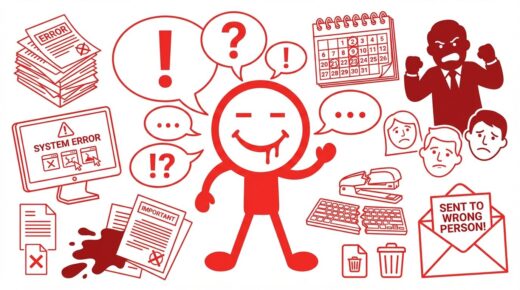
Introduction: Everyone Makes Mistakes
“That was bad… I really messed up.”
If you’ve ever felt this way at work, you’re not alone. No matter how careful we are, mistakes happen. What truly matters is what we learn from them and how we use those lessons to improve.
In this article, we’ll look at five realistic workplace failure stories. For each one, we’ll explore why the mistake happened and what could have prevented it.
Mistake 1: Sending Confidential Information to the Wrong Email Recipient
What Happened
A, a third-year sales representative, was preparing a quotation email for an important client. The email was supposed to go to Mr. Tanaka, a department manager at Tanaka Trading. However, A accidentally sent it to Mr. Tanaka at a competing company.
The email contained sensitive information such as cost structure, profit margins, and discount limits. Five seconds after hitting “Send,” A realized the mistake and turned pale.
A immediately reported the issue to their manager and contacted the competitor, but the email had already been opened. Fortunately, the competitor responded professionally, and the situation didn’t escalate. Still, A spent several sleepless nights afterward.
Why Did This Happen?
- Autocomplete pitfalls
Typing “Tanaka” brought up multiple contacts. A clicked the first one without checking. - Skipping the final check
A was overconfident because it was a routine task. - Stress and time pressure
A was dealing with multiple issues that day and felt rushed. - Lack of system safeguards
The company’s email system didn’t have a confirmation dialog for external recipients.
How to Prevent This Mistake
Individual Actions
- Adopt a 3‑point check before sending
- Are the TO/CC/BCC fields correct?
- Does the subject match the content?
- Are the attachments correct?
- Use the “draft → cool‑down → send” rule
Save the email, wait 5 minutes, then review. - Don’t rely solely on autocomplete
Always verify full name + company.
Organizational Actions
- Implement email‑misdelivery prevention tools
- Require double‑checks for sensitive information
- Organize and standardize address book entries
What Happened Afterward
A created a personal pre‑send checklist and shared it with the team. This led to a department‑wide improvement in email accuracy.
Mistake 2: Poor Schedule Management Leading to Triple Booking
What Happened
B, a project manager handling multiple projects, arrived at work one Monday morning and realized something terrible:
- 2:00 PM – Client progress meeting
- 2:00 PM – Internal budget meeting
- 2:30 PM – Kickoff meeting for a new project (with the CEO attending)
All scheduled on the same day.
B scrambled to reschedule everything, but the client was especially disappointed, saying, “How can you not manage your own schedule?”
Why Did This Happen?
- Using multiple calendar tools
Company calendar, Google Calendar, and a paper planner—none synced. - Relying on verbal agreements
The client meeting was set over the phone and never entered into the calendar. - Weak notification settings
Reminders were set only for the morning of the event. - Overpacked schedule
No buffer time.
How to Prevent This Mistake
Individual Actions
- Use one calendar system
- Enter appointments immediately
- Set multiple reminders
- Review your weekly schedule every Friday
- Add 30‑minute buffers between meetings
Organizational Actions
- Set rules for scheduling important meetings
- Use shared calendars effectively
- Define meeting priority guidelines
What Happened Afterward
B consolidated everything into Google Workspace and created a weekly review habit. Double bookings dropped to zero, and trust was restored.
Mistake 3: Losing Important Data Due to No Backup
What Happened
C from the planning department spent three months creating a 200‑page proposal. The day before the presentation, the file became corrupted and wouldn’t open.
C had no backups—everything was stored in a single file on the local drive.
IT tried to recover it but couldn’t. C had to rebuild the proposal overnight using old fragments from emails and teammates.
Why Did This Happen?
- Lack of backup awareness
- Not using cloud storage
- No version control
- No shared access
How to Prevent This Mistake
Individual Actions
- Follow the 3‑2‑1 backup rule
- Enable automatic cloud sync
- Use versioned filenames
- End each day with a 5‑minute backup routine
Organizational Actions
- Make cloud storage mandatory
- Provide backup training
- Use shared project folders
- Conduct periodic backup audits
What Happened Afterward
C became known as the “Backup Master” and helped the entire department adopt better data‑protection habits.
Mistake 4: Misunderstanding Client Requirements and Wasting a Month of Work
What Happened
D, a web designer, received a request for a “bright and friendly” website. D interpreted this as colorful, playful, and childlike.
But the client—a B2B company targeting business professionals—actually meant “clean, modern, and approachable.”
The design had to be completely redone.
Why Did This Happen?
- No clarification of abstract terms
- No reference examples
- No interim check‑ins
- Weak target analysis
- No documented design concept
How to Prevent This Mistake
Individual Actions
- Ask clarifying questions
- Request at least three reference sites
- Create a mood board
- Share progress regularly
- Always send meeting minutes
Organizational Actions
- Standardize client‑interview sheets
- Require milestone approvals
- Use design‑concept templates
What Happened Afterward
D doubled the time spent on initial interviews and added weekly progress updates. As a result, rework dropped to zero and client satisfaction increased dramatically.
Mistake 5: Failing to Report Issues Early and Making the Problem Worse
What Happened
E, a sales assistant, received a complaint from a major client about a delayed shipment. E discovered a logistics error but didn’t report it to their manager, thinking they could fix it alone.
The next day, the client escalated the complaint directly to the company president.
The manager was furious:
“If you had told me yesterday, I could have apologized immediately and prevented this.”
The relationship with the client—responsible for 10% of annual revenue—was severely damaged.
Why Did This Happen?
- Lack of reporting habits
- Underestimating the issue
- Fear of being blamed
- No escalation rules
- Misunderstanding customer expectations
How to Prevent This Mistake
Individual Actions
- Report issues immediately
- Follow clear timing rules
- Use 5W1H for concise reporting
- Share both good and bad news separately
- Provide solutions along with the report
Organizational Actions
- Create escalation flowcharts
- Build a psychologically safe environment
- Hold regular reporting meetings
- Share failure cases as learning opportunities
What Happened Afterward
E began reporting even small concerns early. This led to quicker resolutions and earned praise from their manager.
Conclusion: Failure Is a Chance to Grow
Across these five stories, several universal principles emerge:
Five Principles to Prevent Mistakes
- Always double‑check
- Back up your data
- Communicate clearly
- Report early
- Build buffer time into your schedule
How to Recover After a Mistake
- Report immediately
- Analyze the cause
- Create prevention measures
- Share what you learned
- Move forward positively
No one is perfect. Mistakes are inevitable—but they are also opportunities for growth.
Use these lessons to improve your work and take your next step with confidence.