
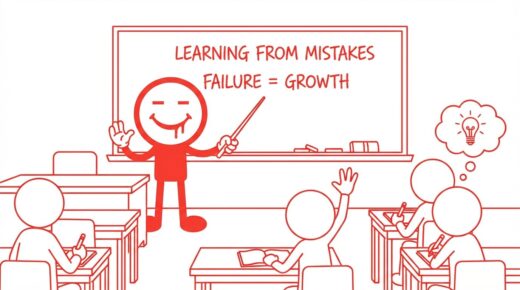
~ Turning Failure into Fuel for Growth ~
Introduction: Failure as “the Best Teacher”
All of us fear failure. Failing an exam, making mistakes in a project, disappointing someone important to us. There is no one who has never experienced that moment when your heart races, cold sweat runs down your back, and you wish you could disappear into a hole. In modern society, failure is often treated as a symbol of “incompetence” or “defeat.” Open social media and you’ll see timelines filled with someone else’s success stories and shining achievements, making you feel as if you alone are falling behind.
However, when we look back at history and examine scientific knowledge, a completely different truth emerges:
Failure is the most efficient and indispensable system for human growth.
A baby learns to walk by falling. Scientists develop new medicines only after thousands of failed experiments. Entrepreneurs create world-changing innovations after enduring bankruptcy and painful setbacks. Failure is not “the end,” but “the beginning”—the very cobblestones paving the road to success.
In this article, we explore the question: “Why do humans learn from failure?”
We will approach this through psychology and neuroscience, discuss the mindset needed to keep challenging ourselves without fear, and examine real stories of people who turned failure into extraordinary success. By the time you finish reading, your definition of “failure” will have changed, and you may find yourself ready to face tomorrow’s challenges with renewed courage.
1. Why Do We Learn from Failure? — The Scientific Mechanism
Prediction Error and the Brain’s Learning Process
From a neuroscience perspective, failure is a “signal for learning.”
Our brain constantly predicts what will happen next—often unconsciously:
- “If I turn this doorknob, the door will open.”
- “If I throw this ball, it will land over there.”
When the result matches the prediction, the brain’s circuits are reinforced, but nothing dramatic happens.
But when the result differs—when we fail—dopaminergic neurons fire intensely. This is known as Reward Prediction Error.
When the expected outcome does not occur, the brain sends a powerful signal:
“Something was wrong. Update the model.”
This signal changes synaptic connections and forms new neural pathways.
In other words, the moment we fail is when the brain is most actively rewriting itself.
If we only experience success, the brain concludes that the current model is sufficient and does not strongly activate learning mechanisms.
Emotion and Memory Consolidation
The strong emotions that accompany failure—pain, embarrassment, frustration—accelerate learning.
When the amygdala (the emotional center) is activated, it signals the hippocampus (the memory center):
“This is important for survival. Store it in long-term memory.”
This is why we remember our embarrassing mistakes far more vividly than something we simply read in a textbook.
From an evolutionary perspective, remembering failures (e.g., approaching a dangerous animal and nearly being attacked) was essential for survival.
Today, the “danger” has shifted from predators to workplace mistakes, but the mechanism remains the same.
2. The Importance of Learning from Failure
Building Resilience
Recovering from failure strengthens what can be called our “psychological muscles.”
Someone who has never fallen does not know how to get back up.
Those who have repeatedly faced small failures and overcome them develop self-efficacy—the belief that “I can handle whatever comes.”
This unbreakable mindset is one of the most powerful tools for navigating today’s uncertain world.
Confidence built only on success is fragile; one major failure can shatter it.
But confidence built on overcoming failure is strong and deeply rooted.
The Source of Innovation
In Silicon Valley, there is a saying:
“Fail fast, fail often.”
Innovation means venturing into areas with no established answers.
Failure is not something to avoid—it is part of the process.
Failure reveals “what doesn’t work.”
This elimination process is what leads to breakthroughs.
Individuals or organizations that do not tolerate failure can only walk safe, predictable paths—and will never produce true innovation.
3. Why People Who Never Fail Eventually Collapse
Some people appear to have lived their lives as “honor students,” avoiding failure and achieving success smoothly.
Ironically, these individuals are at higher risk of experiencing severe setbacks later in life—and being unable to recover.
The Trap of Perfectionism and the “Glass Mind”
People who have never failed often base their identity on being “successful” or “never wrong.”
This is known as a Fixed Mindset—the belief that ability is innate and failure proves a lack of talent.
For them, failure is not a learning opportunity—it is self-negation.
Thus, even a small mistake can cause their mental state to shatter like glass.
They may hide mistakes or blame others, ultimately making the situation worse.
The Invisible Failure: Lost Opportunities
The biggest problem with “not failing” is that it means not challenging anything.
People who avoid failure unconsciously choose only battles they can win.
By avoiding risk, they lose opportunities for growth, new careers, and unexpected encounters.
Research shows that at the end of life, people regret not the failures they experienced, but the chances they never took.
4. Case Studies: Turning Failure into Success
The biographies of great individuals are, without exception, catalogs of failure.
They were not great because they avoided failure, but because they continuously turned failure into fuel.
Steve Jobs: From Exile to Revival
One of the most famous stories of failure and comeback.
Steve Jobs was expelled from Apple—the company he founded—at age 30.
He later said:
“Getting fired from Apple was the best thing that could have happened to me.”
Freed from the burden of being a “successful figure,” he regained the lightness of a beginner and founded NeXT and Pixar.
Without this period of trial and error, the iPhone and iPad might never have been born.
Through failure, he transformed from an arrogant leader into a mature one.
Thomas Edison: 10,000 Discoveries
“I have not failed. I’ve just found 10,000 ways that won’t work.”
Behind this famous quote lies extraordinary persistence.
To find the right filament for the light bulb, he tested plants from around the world—even a friend’s beard.
For him, failure was not emotional disappointment—it was data.
This objective view of failure is the essence of scientific thinking.
Soichiro Honda: Rising from Rubble
The founder of Honda Motor Co. faced countless failures.
His piston rings were rejected by Toyota.
His factory was destroyed by air raids during the war.
The rebuilt factory collapsed in an earthquake.
Having lost everything, he attached surplus radio generator engines to bicycles—creating the first motorized bike, the “Bata-Bata.”
His words, “Success is built on 99% failure,” carry the weight of lived experience.
J.K. Rowling: Magic Born from Rock Bottom
Before Harry Potter was published, Rowling was at the lowest point in her life—divorced, on welfare, and suffering from depression.
Her manuscript was rejected by 12 publishers.
In her Harvard commencement speech, she said:
“Failure stripped away the inessential.”
Hitting rock bottom freed her to focus all her energy on what truly mattered—writing.
5. Why You Should Not Fear Failure — The Mindset
Adopt a Growth Mindset
Stanford professor Carol Dweck introduced the concept of the Growth Mindset.
- Fixed Mindset: Ability is fixed; failure proves lack of talent.
- Growth Mindset: Ability grows through effort; failure is part of the process.
Use the phrase “Not yet.”
Not “I failed,” but “I haven’t succeeded yet.”
The brain is plastic—it can grow throughout life.
Redefine Failure: Understand the Spotlight Effect
We fear failure because of “what others will think.”
But psychology tells us about the Spotlight Effect—we believe others are watching us far more than they actually are.
People are busy with their own lives.
They forget your failures within minutes.
The only person who remembers your failure for years is you.
Knowing this alone reduces fear dramatically.
6. Practical Approaches to Using Failure
1. Perform a “Post-Mortem”
Instead of just feeling bad, analyze failure like a surgeon:
- What happened? (Facts)
- Why did it happen? (Causes)
- How can I prevent it next time? (Countermeasures)
Writing this down turns failure into useful data.
2. Make Small, Intentional Failures (Little Bets)
You don’t need to take huge risks.
Conduct small experiments within acceptable limits.
Small failures cause little damage but yield valuable learning.
This gradually builds tolerance for failure.
3. Practice Self-Compassion
Don’t be too harsh on yourself.
Self-criticism lowers motivation and solves nothing.
Speak to yourself as you would to a close friend:
“You didn’t get it right this time, but you tried. Next time, adjust this part.”
Conclusion: Scars Are Proof of Courage
Japan has a traditional art called Kintsugi—repairing broken pottery with lacquer and decorating the cracks with gold.
The repaired piece becomes more beautiful and valuable than before.
Our lives are the same.
The cracks from failure and setbacks should not be hidden.
When we mend them with learning and growth, our lives gain depth and beauty.
A life without failure is like a brand-new bowl with no marks—clean, but without a story.
A life filled with failures and comebacks shines with the beauty of Kintsugi.
If you are suffering from a failure right now, remember this:
Your pain is proof that you are growing.
Your brain is rewiring itself, upgrading you into a new version.
Move forward.
Dive into failure.
Learn from it.
You already possess the power to rise again.
This article is dedicated to everyone who dares to challenge without fear of failure.